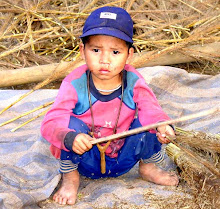
A particular organization that is known worldwide has a program where they collect gift boxes filled with various novelties from people in the West to give as Christmas gifts to people in impoverished countries. A friend of mine here at The Location was contacted by a representative for this organization in a neighboring country. The rep was going to give my friend (a national and a Christian leader) charge of 200 boxes to distribute in The Location.
After bringing the boxes into the country my friend proceeded to give them to every family in his community who was of the same tribal group as him. These were his "target" people, so to speak, since he spoke their tribal language and had led people to Christ mostly from his same tribe. He hoped that by "showing the free love of Christ" people would be interested in following him. He wanted people to see that he was giving these things to them free of charge and that there would be no strings attached.
These activities almost got him put into prison. After distributing the boxes and being interviewed by the local television station (where he answered the question as to the boxes origin: from God) he was called in by the police. So was his wife. They endured long interrogations about the boxes, their involvement, their association with foreigners, the source of the boxes and what they were trying to accomplish. My friend was able to escape imprisonment but the police watched his every move from then on. They viewed him with suspicion and as a threat. Why?
In The Location to give someone something for free is to try to influence them to agree with you about something. That could be religion or politics. In fact, to the government authorities here, religion IS politics. In their eyes, spreading religion (specifically Christianity--the "Western Religion") is how foreigners (specifically "imperialist Americans") make poor peoples oppose their own government and become traitors to society.
So, those who give things away so easily will be forced out. Those who receive things will be persecuted.
In The Location a prevalent question national Christians are asked is, "What did you get to become a Christian?" They don't ask IF the person received something, just WHAT did they receive. It is assumed they did. For what other reason would they become a Christian? It is assumed that the reasons are: Money. Opportunity. Health care. English education. A job. Unfortunately, for too many, those are the exact reasons.
I have often said that our situation here in The Location (a "closed" country) forces us to do things right. In the next post I will share what I mean....
Showing posts with label Dependency. Show all posts
Showing posts with label Dependency. Show all posts
Friday, March 13, 2009


Tuesday, March 10, 2009
Dependency Mission 06
"What's wrong with dependency? If we are doing something to help people, isn't that a good thing?"
I've heard from some people that have not liked what I've had to say about dependency (not on this site). It is interesting. Usually they will tell me about some mission organization or approach they know of or have experience with. They receive my critique as a condemnation. It is like they feel you have to throw the baby out with the bathwater so they therefore decide to keep the bathwater.
My purpose is not to condemn anything people do out of the goodness of their hearts when done in all honesty and integrity. At the same time, our "good intentions" do not exempt us from being intelligent and learning to see if there are better ways. Jesus said we must be as innocent as doves AND as smart as serpents.
So, to counter another misconception, I don't believe it is wrong or bad for people like us to give gifts to people in poor countries. I'm not against that. That is not what I'm talking about in my Dependency Mission series. I'm talking about mission programs that simply form a never-ending conduit of foreign funds to subsidize normal every-day physical needs of those in poverty or to sponsor native evangelists in an ongoing fashion.
I am not against using foreign funds to address emergency needs and I know of several organizations who raise money for such situations around the world. They do good work. However, the nature of an emergency (flood, tsunami, famine, refugee camp, etc.) is that it is not ongoing, and such organizations are helping people until they can achieve stability again.
Neither am I against using foreign funds to start up projects in unreached places that have the goal of sustainability. It might take a while to get to the point where they can support themselves, but it is the goal and the plan. This is not unlike my own situation.
Also, I want everyone to know that I am not in the least against native missionaries! I am all for national evangelists, national pastors and national Christians doing ministry in and among their own people. In fact, I would be opposed to any organization that insisted only foreigners from the West with seminary training can do ministry on the field. That would be terrible! I am simply against unending sponsorship of national Christian workers. Why?
The biggest reason is that it is not reproducible.
If I support ten national evangelists to go and plant churches in unreached villages in The Location, then perhaps we will have helped plant ten churches. But what happens when 30 other nationals want to plant churches? Two things. They will see the others who have planted churches and assume that the only way to plant a church is to be sponsored by a foreigner. Then they will either try to find funding from foreigners or they will give up and not do anything. Our model then becomes a barrier to church growth.
If the only churches we plant are the ones that are funded from outside sources then church growth will go very slowly. How can it be reproduced on the field without outside help? It would be very difficult if not impossible. And if someone came along and planted a church without a big budget, but did it in a low-key way (say, a house church), then the national leaders of the big foreign-subsidized churches would likely say, "You're not a REAL church." And, yes, this really does happen.
In the history of the church most major expansions of the church have come through people movements where many people come to Christ in a rather short period of time (history-wise). And such movements have occurred when the peoples of those places have shared the gospel and started churches on their own. They haven't depended upon outside sources for the expansion of the movement, even if it might have been initiated by outside Christians. If I am going to light a forest on fire it would take a very long time to go around and ignite every single tree. But if I lit one tree on fire and it spread to other trees on its own, then the mission will be best accomplished.
This is reproducibility. It means that anything we as foreigners do in ministry we do it in a way that nationals can easily copy and do on their own. If they are dependent upon us for funding for any kind of ministry they do, then it will not be possible for them to reproduce. Then the only thing that will happen will be what we (foreigners) can do or what we can fund. Our good works just might end up being a barrier to the spread of the gospel.
Your thoughts?
Tomorrow I will share some stories from The Location about well-intentioned programs...
I've heard from some people that have not liked what I've had to say about dependency (not on this site). It is interesting. Usually they will tell me about some mission organization or approach they know of or have experience with. They receive my critique as a condemnation. It is like they feel you have to throw the baby out with the bathwater so they therefore decide to keep the bathwater.
My purpose is not to condemn anything people do out of the goodness of their hearts when done in all honesty and integrity. At the same time, our "good intentions" do not exempt us from being intelligent and learning to see if there are better ways. Jesus said we must be as innocent as doves AND as smart as serpents.
So, to counter another misconception, I don't believe it is wrong or bad for people like us to give gifts to people in poor countries. I'm not against that. That is not what I'm talking about in my Dependency Mission series. I'm talking about mission programs that simply form a never-ending conduit of foreign funds to subsidize normal every-day physical needs of those in poverty or to sponsor native evangelists in an ongoing fashion.
I am not against using foreign funds to address emergency needs and I know of several organizations who raise money for such situations around the world. They do good work. However, the nature of an emergency (flood, tsunami, famine, refugee camp, etc.) is that it is not ongoing, and such organizations are helping people until they can achieve stability again.
Neither am I against using foreign funds to start up projects in unreached places that have the goal of sustainability. It might take a while to get to the point where they can support themselves, but it is the goal and the plan. This is not unlike my own situation.
Also, I want everyone to know that I am not in the least against native missionaries! I am all for national evangelists, national pastors and national Christians doing ministry in and among their own people. In fact, I would be opposed to any organization that insisted only foreigners from the West with seminary training can do ministry on the field. That would be terrible! I am simply against unending sponsorship of national Christian workers. Why?
The biggest reason is that it is not reproducible.
If I support ten national evangelists to go and plant churches in unreached villages in The Location, then perhaps we will have helped plant ten churches. But what happens when 30 other nationals want to plant churches? Two things. They will see the others who have planted churches and assume that the only way to plant a church is to be sponsored by a foreigner. Then they will either try to find funding from foreigners or they will give up and not do anything. Our model then becomes a barrier to church growth.
If the only churches we plant are the ones that are funded from outside sources then church growth will go very slowly. How can it be reproduced on the field without outside help? It would be very difficult if not impossible. And if someone came along and planted a church without a big budget, but did it in a low-key way (say, a house church), then the national leaders of the big foreign-subsidized churches would likely say, "You're not a REAL church." And, yes, this really does happen.
In the history of the church most major expansions of the church have come through people movements where many people come to Christ in a rather short period of time (history-wise). And such movements have occurred when the peoples of those places have shared the gospel and started churches on their own. They haven't depended upon outside sources for the expansion of the movement, even if it might have been initiated by outside Christians. If I am going to light a forest on fire it would take a very long time to go around and ignite every single tree. But if I lit one tree on fire and it spread to other trees on its own, then the mission will be best accomplished.
This is reproducibility. It means that anything we as foreigners do in ministry we do it in a way that nationals can easily copy and do on their own. If they are dependent upon us for funding for any kind of ministry they do, then it will not be possible for them to reproduce. Then the only thing that will happen will be what we (foreigners) can do or what we can fund. Our good works just might end up being a barrier to the spread of the gospel.
Your thoughts?
Tomorrow I will share some stories from The Location about well-intentioned programs...
Monday, March 9, 2009
Dependency Mission 05
If we are going to support a particular mission program that works with the poor one of the things we should research is whether or not they are creating dependency in their efforts to lift people out of poverty. We can certainly help someone out of poverty by simply giving them an unending source of money. But then we have only made them dependent upon us for that "lifeline" and it could never go much beyond our own means. It is better if we can give them ways to escape poverty without creating dependency upon rare outside sources.
If you give a man a fish you feed him for a day. If you teach a man to fish you feed him for a lifetime.
Do you remember that proverb? It's a good one. Paul teaches us in 2 Thessalonians 3:7-12:
"We were not idle when we were with you, nor did we eat anyone's food without paying for it. On the contrary, we worked night and day, laboring and toiling so that we would not be a burden to any of you. We did this, not because we do not have the right to such help, but in order to make ourselves a model for you to follow. For even when we were with you, we gave you this rule: 'If a man will not work, he shall not eat.' We hear that some among you are idle. They are not busy; they are busybodies. Such people we command and urge in the Lord Jesus Christ to settle down and earn the bread they eat."
He also says in 1 Thessalonians 4:11-12:
"Make it your ambition to lead a quiet life, to mind your own business and to work with your hands, just as we told you, so that your daily life may win the respect of outsiders and so that you will not be dependent on anybody."
Paul's goal is not that people would simply become recipients of missionary's help, but that they would be better workers than before, because of their faith, and that they would be able to contribute, not just consume.
Many people talk about two types of mission work--helping people spiritually (evangelism, discipleship, church planting, etc.) and helping people physically (relief efforts, feeding programs, micro financing, agriculture, water systems, etc.) And we tend to think of dependency in the realm of physical help. But dependency can happen in two ways:
1) Making people dependent upon us for their physical needs.
2) Making people dependent upon us for the spiritual needs.
If we do a program where we feed people--Are there ways to help them to be able to feed themselves?
If we do a church plant where we teach/preach to people--Are there ways to train a few to be able to teach themselves?
If we send out national evangelists and support them with our funds--Are there ways to help them to be able to support themselves or for the local churches to be able to support them?
These are the questions and issues we must address to get around creating dependency.
Tomorrow I'll attempt to answer the question: "What's wrong with dependency? If we are doing something to help people, isn't that a good thing?"
If you give a man a fish you feed him for a day. If you teach a man to fish you feed him for a lifetime.
Do you remember that proverb? It's a good one. Paul teaches us in 2 Thessalonians 3:7-12:
"We were not idle when we were with you, nor did we eat anyone's food without paying for it. On the contrary, we worked night and day, laboring and toiling so that we would not be a burden to any of you. We did this, not because we do not have the right to such help, but in order to make ourselves a model for you to follow. For even when we were with you, we gave you this rule: 'If a man will not work, he shall not eat.' We hear that some among you are idle. They are not busy; they are busybodies. Such people we command and urge in the Lord Jesus Christ to settle down and earn the bread they eat."
He also says in 1 Thessalonians 4:11-12:
"Make it your ambition to lead a quiet life, to mind your own business and to work with your hands, just as we told you, so that your daily life may win the respect of outsiders and so that you will not be dependent on anybody."
Paul's goal is not that people would simply become recipients of missionary's help, but that they would be better workers than before, because of their faith, and that they would be able to contribute, not just consume.
Many people talk about two types of mission work--helping people spiritually (evangelism, discipleship, church planting, etc.) and helping people physically (relief efforts, feeding programs, micro financing, agriculture, water systems, etc.) And we tend to think of dependency in the realm of physical help. But dependency can happen in two ways:
1) Making people dependent upon us for their physical needs.
2) Making people dependent upon us for the spiritual needs.
If we do a program where we feed people--Are there ways to help them to be able to feed themselves?
If we do a church plant where we teach/preach to people--Are there ways to train a few to be able to teach themselves?
If we send out national evangelists and support them with our funds--Are there ways to help them to be able to support themselves or for the local churches to be able to support them?
These are the questions and issues we must address to get around creating dependency.
Tomorrow I'll attempt to answer the question: "What's wrong with dependency? If we are doing something to help people, isn't that a good thing?"
Sunday, March 8, 2009
Dependency Mission 04
One mission agency that collects funds to support native missionaries built a Bible college to train them before sending them out. They visited many villages asking them each to send students to come study and then they would be supported as native missionaries for a certain monthly amount. Each village could send two students for free. What happened? People who weren't even Christians were enrolling in the school. It was free. They could learn to lead religious services for another religion if someone was going to pay them to do it. They said all the right things and went through all the right hoops. We don't know if the administrators ever found out or if they were concerned about this problem.
In The Location a certain missionary worked with the pastor of one of the local churches. He noticed this pastor was always asking for things from all the foreigners who lived in town. He would ask for tiling for his house/church, instruments, a digital camera, a computer, a printer, a motorcycle, money to buy land, money for English school, money for his son to get married, etc. The missionary tried to give the pastor opportunities to work during the week so that he could earn enough money to purchase these things for himself. The pastor spent most of his time at home during the week without much to do other than going around and asking people for money. When he finally had an opportunity to work with a certain employer, he declined because he found other missionaries who were willing to just give him all the stuff he asked for without having to work. Now he has a computer at his house that he doesn't know how to use.
An Arab travel guide in the "Holy Land" noticed that many of the groups coming over on tours were American Christians who had little experience in other cultures. Many of them were nervous and excited about meeting a real live Muslim for the first time in their lives. And as a result, they would often try different subtle and some not-so-subtle ways to evangelize him. This man discovered that if he "converted" to Christianity he would get bigger tips than when he wouldn't convert. Consequently, every time he led a group that tried to share Christ he would act like he didn't know anything, pray a prayer of acceptance with them, and "convert" to Christianity. He was able to make a lot of money.
The last story is more of a "deceive those suckers" than a dependency story. But many more stories could be told.
It seems to me that the danger in the common mission agency practice of giving lots of things to poor people on the "mission field" is in creating a welfare state. You know what I'm talking about. People in our own country don't want to go out and get a job because it is easier just to live on government assistant checks. Then we have to ask the question of whether or not those assistance programs are working or just continuing and adding to the problem.
Most mission agencies (that are honest, and I believe most of them are honest) would be aghast at the thought that their programs are contributing to such a "welfare state" type situation. The problem is that we often don't realize how little it takes to do this. You see, if in the US a person got a government assistance check for $100 a month, it wouldn't be enough to live on. They would still need to go out and get a job. But half of that amount (what we might spend on one nice dinner) is more than enough for people to live on in many of the poorest countries of the world. It is not wrong to be generous, but we simply need to be aware of the potential negative situation we might be creating or contributing to. Are there better ways to help them help themselves rather than simply making them dependent upon us indefinitely?
Do you have a story? If so, please share.
Tomorrow I'll share some scriptures on the subject of dependency...
In The Location a certain missionary worked with the pastor of one of the local churches. He noticed this pastor was always asking for things from all the foreigners who lived in town. He would ask for tiling for his house/church, instruments, a digital camera, a computer, a printer, a motorcycle, money to buy land, money for English school, money for his son to get married, etc. The missionary tried to give the pastor opportunities to work during the week so that he could earn enough money to purchase these things for himself. The pastor spent most of his time at home during the week without much to do other than going around and asking people for money. When he finally had an opportunity to work with a certain employer, he declined because he found other missionaries who were willing to just give him all the stuff he asked for without having to work. Now he has a computer at his house that he doesn't know how to use.
An Arab travel guide in the "Holy Land" noticed that many of the groups coming over on tours were American Christians who had little experience in other cultures. Many of them were nervous and excited about meeting a real live Muslim for the first time in their lives. And as a result, they would often try different subtle and some not-so-subtle ways to evangelize him. This man discovered that if he "converted" to Christianity he would get bigger tips than when he wouldn't convert. Consequently, every time he led a group that tried to share Christ he would act like he didn't know anything, pray a prayer of acceptance with them, and "convert" to Christianity. He was able to make a lot of money.
The last story is more of a "deceive those suckers" than a dependency story. But many more stories could be told.
It seems to me that the danger in the common mission agency practice of giving lots of things to poor people on the "mission field" is in creating a welfare state. You know what I'm talking about. People in our own country don't want to go out and get a job because it is easier just to live on government assistant checks. Then we have to ask the question of whether or not those assistance programs are working or just continuing and adding to the problem.
Most mission agencies (that are honest, and I believe most of them are honest) would be aghast at the thought that their programs are contributing to such a "welfare state" type situation. The problem is that we often don't realize how little it takes to do this. You see, if in the US a person got a government assistance check for $100 a month, it wouldn't be enough to live on. They would still need to go out and get a job. But half of that amount (what we might spend on one nice dinner) is more than enough for people to live on in many of the poorest countries of the world. It is not wrong to be generous, but we simply need to be aware of the potential negative situation we might be creating or contributing to. Are there better ways to help them help themselves rather than simply making them dependent upon us indefinitely?
Do you have a story? If so, please share.
Tomorrow I'll share some scriptures on the subject of dependency...
Saturday, March 7, 2009
Dependency Mission 03
I think it would behoove all of us who give to missions to learn ways to evaluate mission approaches to see if what we're supporting is making the kind of difference we want it to make. We need to educate ourselves.
I have seen it myself. Missionaries who come to town (meaning here on "the field") with big budgets and big programs can generate quite a stir. Everyone loves them. They do grand things and give a lot to many people. They gather big crowds. Many people want to get as close as they can to them. The missionaries see all these people coming and they praise God for how the Spirit is impacting so many. They sometimes boast to others about "all that God is doing" in their ministry.
Usually what follows is jealousy and infighting among the locals regarding who is closest to the missionary. Why? Because it never was about what God was doing among the people. It was about money. Easy money. The people found the missionary to be an easy source of money, help, education, etc. In other words: a sucker. "We'll do the Christian dance for you if you give us money." And many people in poor countries view charitable foreigners as suckers.
A generation ago some missionaries came up with a term for local peoples who come to Christ in order to get some sort of financial or physical benefit: Rice Christians. "If you give me a bowl of rice, I will become a Christian." This dynamic is not dead in the least. It is very prevalent in poor countries where missionaries work. The task for the missionary, then, is to figure out ways to avoid this dynamic.
The problem is that too many missionaries ignore this syndrome and throw their money around. They feel justified because they can credit God with all the activity and excitement they are generating. Then they turn around and report this activity and the numbers of all the people at their events in their newsletters. This then helps them raise more money because people back home are so excited to give to a mission work that "God is really using."
And some of the most popular mission agencies in the States are the very ones that are dumping money (in various forms) on the field and the people they are "reaching" are actually being converted to loving wealth more than God.
Tomorrow I will tell you a couple stories...
I have seen it myself. Missionaries who come to town (meaning here on "the field") with big budgets and big programs can generate quite a stir. Everyone loves them. They do grand things and give a lot to many people. They gather big crowds. Many people want to get as close as they can to them. The missionaries see all these people coming and they praise God for how the Spirit is impacting so many. They sometimes boast to others about "all that God is doing" in their ministry.
Usually what follows is jealousy and infighting among the locals regarding who is closest to the missionary. Why? Because it never was about what God was doing among the people. It was about money. Easy money. The people found the missionary to be an easy source of money, help, education, etc. In other words: a sucker. "We'll do the Christian dance for you if you give us money." And many people in poor countries view charitable foreigners as suckers.
A generation ago some missionaries came up with a term for local peoples who come to Christ in order to get some sort of financial or physical benefit: Rice Christians. "If you give me a bowl of rice, I will become a Christian." This dynamic is not dead in the least. It is very prevalent in poor countries where missionaries work. The task for the missionary, then, is to figure out ways to avoid this dynamic.
The problem is that too many missionaries ignore this syndrome and throw their money around. They feel justified because they can credit God with all the activity and excitement they are generating. Then they turn around and report this activity and the numbers of all the people at their events in their newsletters. This then helps them raise more money because people back home are so excited to give to a mission work that "God is really using."
And some of the most popular mission agencies in the States are the very ones that are dumping money (in various forms) on the field and the people they are "reaching" are actually being converted to loving wealth more than God.
Tomorrow I will tell you a couple stories...
Thursday, March 5, 2009
Dependency Mission 02
"Just $30 a month and you can support a native missionary who already knows the language and the culture, and who will risk their lives to preach the gospel to thousands."
Sounds good, right? There are a number of mission agencies in the world who advertise like this. One in particular will give you a free book telling you why Westerners should not be missionaries because it takes more than $30,000 to move them there and that same money could support hundreds of native missionaries who don't have to go through language training or worry about culture shock.
Many times I've been asked the same question: "Why should we come visit you when we could just send the money from the plane ticket to hire locals to do the same work?" And in many cases, I do think sending some money would be a better thing to do. In other cases, I don't think very much money ever comes in from people who've almost decided to go.
But arguments for supporting native missionaries, sponsoring children and donating to missionary charity efforts tend to rely on making sure you know that we over here (on the mission field) are better off if you give us your money versus you spending that money on something else, whether that be a trip to the field or a swimming pool in your back yard. So the only thing you consider is whether you should give your money to "missions" or spend it on yourself. You can see where this is leading. You feel guilty spending money on yourself so you give it to missions.
What is usually left out of consideration (and many agencies don't want you to go there) is whether or not the missions program you are giving to is a good thing. Most just assume, "It's missions so it's all good." "They're helping the poor--what could be wrong with that?" "We have so much compared to them. What is just a little for us really goes a long way over there."
Sounds good, right? There are a number of mission agencies in the world who advertise like this. One in particular will give you a free book telling you why Westerners should not be missionaries because it takes more than $30,000 to move them there and that same money could support hundreds of native missionaries who don't have to go through language training or worry about culture shock.
Many times I've been asked the same question: "Why should we come visit you when we could just send the money from the plane ticket to hire locals to do the same work?" And in many cases, I do think sending some money would be a better thing to do. In other cases, I don't think very much money ever comes in from people who've almost decided to go.
But arguments for supporting native missionaries, sponsoring children and donating to missionary charity efforts tend to rely on making sure you know that we over here (on the mission field) are better off if you give us your money versus you spending that money on something else, whether that be a trip to the field or a swimming pool in your back yard. So the only thing you consider is whether you should give your money to "missions" or spend it on yourself. You can see where this is leading. You feel guilty spending money on yourself so you give it to missions.
What is usually left out of consideration (and many agencies don't want you to go there) is whether or not the missions program you are giving to is a good thing. Most just assume, "It's missions so it's all good." "They're helping the poor--what could be wrong with that?" "We have so much compared to them. What is just a little for us really goes a long way over there."
But just continually supporting native missionaries or sponsoring a child can create dependency. More on this later.
What about you? Do you have experience in giving out of guilt while assuming the recipient has a worthy program?
Tomorrow I will share with you about what happens when some missionaries come to town with big plans...
Dependency Mission 01
We in the church in America are pretty uneducated when it comes to missions. This is improving in some small incremental ways thanks the the explosion of mission-trip going during our vacations. But sometimes mission trips tend to reinforce our misunderstandings about missions rather than educate us. That is because our week-long trips are so short that it is impossible for us to learn anything beyond what someone who lives there permanently tells us. Still, we come back home as experts and spout off all of our knowledge. If anyone questions us we say, "I've been there!" Since most others haven't been there, the argument is finished.
Most of us see missions as exotic charity. We are the haves. They are the have-nots. So, we give what we have to them. Then we take a picture of a white person hugging a dark-skinned kid and publish it in our churches and newsletters. Those who see the picture are touched and impressed. In fact, there is not much more impressive (to us who are Christians) than "giving up" your life, moving to a "third-world" country and giving things to dark-skinned poor people like health care, food, clothing, dental care, soap, toothbrushes, education, English lessons and... oh yes, church. In fact, we give all of those things in the name of Jesus and the church.
But have you ever considered (and I'm speaking as a Christ-follower, a missionary and someone who wants to see the kingdom of God expand--NOT as someone who is anti-Christian or anti-missionary) that these things might be doing more harm than good?
Tell me what you think.
Tomorrow I'll share about how mission agency advertising pulls us into certain ruts...
Most of us see missions as exotic charity. We are the haves. They are the have-nots. So, we give what we have to them. Then we take a picture of a white person hugging a dark-skinned kid and publish it in our churches and newsletters. Those who see the picture are touched and impressed. In fact, there is not much more impressive (to us who are Christians) than "giving up" your life, moving to a "third-world" country and giving things to dark-skinned poor people like health care, food, clothing, dental care, soap, toothbrushes, education, English lessons and... oh yes, church. In fact, we give all of those things in the name of Jesus and the church.
But have you ever considered (and I'm speaking as a Christ-follower, a missionary and someone who wants to see the kingdom of God expand--NOT as someone who is anti-Christian or anti-missionary) that these things might be doing more harm than good?
Tell me what you think.
Tomorrow I'll share about how mission agency advertising pulls us into certain ruts...
Subscribe to:
Posts (Atom)